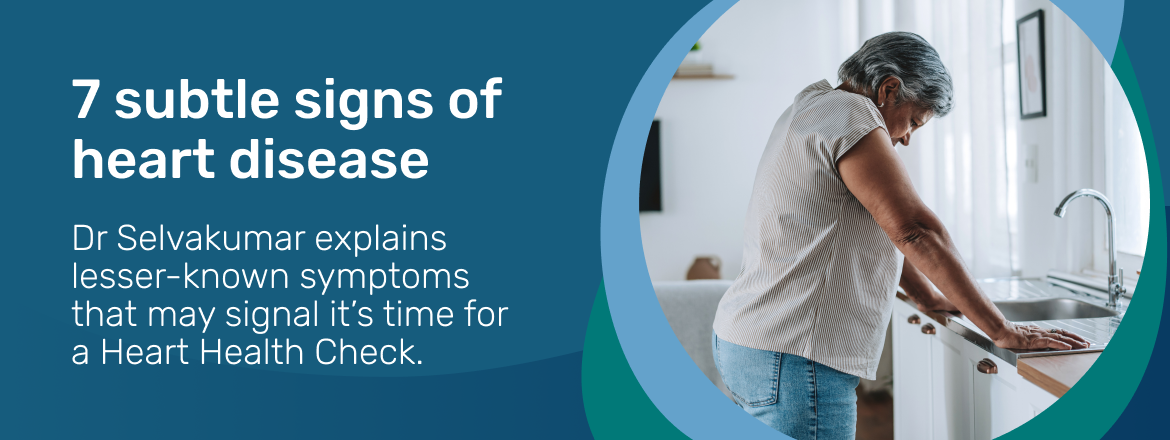
When you think about signs of heart trouble, what comes to mind? Probably someone clutching their chest and gasping for breath. While this can happen during a heart attack, your body may be sending more subtle signs that your heart could do with some TLC.
When it comes to heart disease statistics, this condition is still a leading cause of death in Australia[i]. Many people don't realise they’re at risk because they feel fine. But almost every Australian adult has at least one risk factor for heart disease[ii].
Even if you feel healthy overall, your heart may be trying to get your attention. Here are 7 lesser-known symptoms of heart disease that suggest you could benefit from a Heart Health Check. And remember, the earlier heart disease is recognised, the sooner you and your doctor can do something about it. This gives you the best chance of a good outcome.
1. Unexplained fatigue
It’s common to put fatigue down to getting older or being too busy. And it’s true that aging, stress and a hectic schedule can affect your energy levels. But are you getting unusually tired for no reason, or after doing things that never used to bother you – like walking around the block or shopping? This could be one of the first signs of heart disease.
Fatigue like this can mean your heart isn't pumping as well as it should, so your muscles and tissues are not getting enough oxygen. This condition is known as heart failure.
In women especially, fatigue can be one of the earliest and most under-recognised signs of heart disease.
2. Unexplained cough or shortness of breath
Find yourself huffing and puffing more than you used to, or breathless while you’re lying flat? This can suggest that fluid is building up in your lungs, which can be a sign of heart failure.
Shortness of breath can also be a sign of:
- a heart rhythm disorder (such as atrial fibrillation)
- lack of blood flow to your heart (known as ischaemic heart disease or coronary heart disease).
While it’s tempting to blame breathlessness on aging or poor fitness, it suggests you should see your GP.
Similarly, a persistent cough can be one of the signs and symptoms of heart disease. A cough caused by heart failure does not go away with antibiotics. You may cough up white, pink, or blood-stained phlegm. You should see your GP if you have a cough that does not go away, or if you cough up any blood.
3. Light-headedness or dizziness
While many things can cause dizziness, it’s also one of the lesser-known heart disease signs. Dizziness or light-headedness can indicate a heart rhythm problem (or arrhythmia). Arrhythmias are caused by abnormal firing in the heart’s electrical system. Arrhythmias can also cause shortness of breath and heart palpitations (a fast or noticeable heartbeat).
4. Swelling in the ankles and feet
Fluid retention in the lower legs is one of the subtle early heart disease warning signs. It can suggest that your heart is not pumping blood efficiently, causing fluid to build up in your lower extremities. So if your shoes feel tighter than usual or your feet and ankles are puffy at the end of the day, it’s worth getting checked out, especially if you have other symptoms like fatigue or breathlessness.
5. Discomfort in the neck, jaw or left arm
Chest pain is the most recognised symptom of a heart condition. But you can experience discomfort from a heart problem in other places, too. Some people feel pain or pressure in the neck, shoulder, left arm, or jaw – even the teeth. In women, especially, pain in the jaw can be a warning sign of a heart attack.
These sensations are often put down to muscle or joint problems. But they may be signs of coronary heart disease and should not be ignored.
6. Cramping or pain in the legs
Do you get cramps or leg pain when you’re walking that go away when you stop and rest? This can suggest your leg muscles are not getting enough blood. This condition is known as peripheral arterial disease (or peripheral vascular disease).
It’s caused by the same process that leads to coronary heart disease. It’s a possible sign that the blood vessels to your heart are narrowed or hardened. If you experience this symptom, book an appointment with your GP.
7. Erectile dysfunction
Heart health and sexual health are closely connected. Erectile dysfunction can be an early marker of poor blood flow due to narrowing of the arteries. It can sometimes start years before other heart symptoms appear.
Erectile dysfunction is not just a quality-of-life issue. It’s an early warning sign that should prompt further investigation.
Is your heart trying to tell you something?
Importantly, these subtle symptoms of heart disease often develop gradually. You might adapt by taking the lift instead of the stairs, going to bed earlier, or avoiding long walks – not realising that your heart is showing signs of strain.
The good news? A Heart Health Check with your GP can find problems early, helping lower the chance of more serious disease.
During this 20-minute visit, your GP will run a heart disease risk assessment. They will ask some questions and do some simple tests – like checking your weight, blood pressure, and cholesterol.
With this information, they can calculate your risk of a heart attack or stroke over the next five years. They can also create a plan to help reduce your risk if needed.
It’s quick, it’s covered by Medicare if you’re over 45 (or over 30 for Aboriginal and Torres Strait Islander Peoples), and it could save your life.
When to see your doctor
If you notice any of the above signs and symptoms of heart disease, it’s worth speaking to your GP. Even if your symptoms are not related to your heart, you’ll be a step closer to finding out what’s behind them.
If your symptoms are severe, getting worse or not going away, call triple zero (000) and ask for an ambulance.
Frequently asked questions
Are sock marks a sign of heart disease?
Sock marks on your legs are often harmless. But if they’re deep, persistent or accompanied by other signs of poor circulation (such as discoloured skin), it could suggest an underlying condition, so see your GP.
How long can you live with ischemic heart disease?
This varies widely depending on the severity of the disease, how early it’s diagnosed and treated, the lifestyle changes you make and more. Many people with ischaemic heart disease can live long, satisfying lives, especially with the effective treatments we have today.
Is heart disease genetic?
If you have a family history of heart disease, you may be at higher risk of developing it yourself. It is possible to inherit genes that are linked with heart disease. You can also take on family habits that raise your risk of heart disease, such as smoking or eating habits. Talk to your GP if you have any concerns about your heart disease risk.
Can heart disease be reversed?
While you cannot cure or ‘reverse’ disease in the coronary arteries, medications and lifestyle changes can help stop or delay it. There is a lot you can do to prevent heart disease and modern therapies can help you live a long, productive life.
[i] Australian Institute of Health and Welfare. Deaths in Australia. Last updated: 09 Apr 2025. Available at https://www.aihw.gov.au/reports/life-expectancy-deaths/deaths-in-australia/contents/leading-causes-of-death. Accessed 25.06.2025.
[ii] AIHW. Heart, stroke and vascular disease: Australian facts. Last updated: 12 Dec 2024. Available at https://www.aihw.gov.au/reports/heart-stroke-vascular-diseases/hsvd-facts/contents/risk-factors/multiple-risk-factors. Accessed 25.06.2025.
Reviewed by Dr Dinesh Selvakumar, interventional cardiologist at Norwest Private Hospital